Thursday, January 26, 2012

URBAN CHINA

URBAN CHINA
Shanghai Magazine / Planning Group 
Has New Finger on the Pulse of China's Future


Special Report for Kyoto Journal  

www.chinadaily.com.cn

www.chinadaily.com.cn

www.chinadaily.com.cn
Whoever controls the wrecking ball usually wins land rights battles, but not necessarily in China anymore. In 2007, for the first time in its history, China had in place legislation that offered equal protection for state and private entities which was quickly put to the test by a growing number of protagonists coined by the media as “nail families”, (ding zi hu). The residents of these households, of no set number of folks, primarily in Beijing, Shanghai and Guangzhou, refuse, even to the point of committing suicide, to move from their dwellings to make way for “progress”. There is one report of demolition company thugs pulling a 54 year old man out of his home and beating him to death.

In addition to challenging the establishment at every level, the plight of these 21st Century folk "heroes" have also captured the imagination of the international media and academic community due in no small part to the striking photographs of remnant buildings crowning Brancusi-like pinnacles in the midst of deep construction canyons.

shanghai.globaltimes.cn
After years of resistance, putting up with condemnation of their buildings, cutting off water and power, and developers’ early offers of financial compensation, most families finally vacate in exchange for significantly larger pay-outs, new residences and additional land to earn a living. One family succumbed by taking a sum equivalent to 1600% of their original purchase price, upwards of $2.7 million! Not every nail family has caved in, however. In Beijing, for example, a six-lane highway completely surrounds the Zhang family’s home. A four-lane highway isolates another holdout family in Shanghai. (Japan and even the USA has "nail families"; farmlands remain within the perimeter of Tokyo's Narita Airport.)

According to Global Times, at the end of January 2011, due to pressure from lawyers, China’s Legislative Affairs Office of the State Council and the Ministry of Housing and Urban-Rural Development issued a joint statement about new legislation that attempts to mitigate disputes over house expropriation and demolition. It strives to give equal consideration to both public interests and property owners' individual rights, and to create a more transparent, level, non-lethal process. It defines the basis for claims of eminent domain; it also rules-out land developers' involvement in the demolition and relocation procedures, outlaws the use of violence means of coercion,  and promotes more equitable financial compensation basis on par with the region.

Mirage Games
When looking at these images from a Western perspective, it’s easy to jump to a conclusion that it's another case of the little guy against the bureaucracy and greedy developers. It is not only tempting to play that duality game, but according to The Wall Street Journal, it is also possible! “Fighting Eviction: the Videogame” is a digital time-killer that pits feisty homesteaders against demo goons hired by property developers, government guards and the ever-present gangsters. As noted in “China Realtime Report”, player avatars include “a woman in curlers who throws sandals at encroaching attackers, a pot-bellied man who drops dynamite from the roof, and an old man with a shotgun. When you win a level, the woman appears, pointing a finger at the Forbidden City, the symbolic center of the government’s power. When you lose, the house collapses in a cloud of dust.” A related blog post points out that film critic Li Chengpeng drew attention for his piece, “Avatar: An Epic Nail House Textbook,” in which he compares the plight of James Cameron’s Na’vi to the people who live in “nail houses”.

Urban China Covers from Facebook
Business Not As Usual

The continuing saga of Mr. and Mrs. Nail and their Little Tack (remember China’s one-child per family!) is not just about rampant development for progress’ sake. Rather, under the bleary eyes of the Internet-glued world, China is taking pains to learn about itself, its huge and massively growing self ... on its own terms.


In the past Chinese people had little agency to petition for a better life than to offer a bundle of smoking sticks of incense and few burning wads of Bank of Hell paper money to offer to a deceased ancestor. Maybe one of them might bribe an official in a dream and affect a more desirable outcome of some terrestrial problem. Even courtiers and bureaucrats sought out auspicious signs and assessed news from “above”.


China's renowned city planning formalities have been emulated by other East Asian population centers. From capital cities to villages geomancy has been highly regarded in societies ruled by emperors, kings, warlords and more "modern" revolutionary dictators. But will principles from Tao to Mao hold up today in support of the world's fastest process of urbanization in recorded history? 

Unlike their predecessors, today’s elected officials, are slowly learning to listen to news from “below”, to observe and understand the ways of the people, not just respond to the needs of the Party. In his introduction to  "The Mystified Boat: Postmodern Stories from China, [1] Manoa Co-Editor Frank Stewart has noted that China’s street-level reality today is fraught with "shifting points of view, characters who misunderstand each other in ways that have direct consequences, unreliable narrators who address readers in order to tell them what to think, events that are improbable or impossible in life outside the story -- these are some of the startling elements possible in life outside the story.”

We can continue to expect great things from the people who brought us  fen shui and Traditional Oriental Medicine; there is a precedent for diagnosing the character of a disharmony -- whether economic or corporeal, and to reinstate its systemic balance by economic readjustment. It's just a matter of scale.

With China's current population around 1.35 billion, capturing the diversity of  opinions and experiences, providing appropriate ways to analyze the information, recognizing trends and taking action is understandably a daunting task, but one that is essential to that big dream of progress. 

A New Finger on the Pulse of China's Urban Future

"It is very difficult to find another civilization in history like China’s, which has been extremely meticulous about control for thousands of years," observed Jiang Jun, Editor-in-Chief of Urban China, in an essay, "Informal China". "This control is not only on political and ideological levels, but is also present in material and spatial realms: from macro-scale urban planning, meso-scale traditional construction rules, to countless micro-scale details of daily life."

Since 2005 Urban China城市中国, has been the only magazine published both in, about and for China devoted to issues of urbanism [2][3]. Jun describes the UC mission as a means to “challenge the way we see this world and, in so doing, re-imagine what the world can be.” 


Urban China’s slogan is “Urban Wisdom Advancing with China”, and its content is at once technical and theoretical, presenting statistical data and analytical considerations. It functions as a research network, think tank, documentary archive, and a tool for artistic production and urban activism.


 A product of its socialist society, Urban China's contents are deeply scrutinized by the Party’s regulatory machinery to assess compliance with the status quo. Nonetheless, its mission is to demystify that same governmental machine; the publication also informs upper echelons of power about the impact of public policy in real time. Unlike American and European sleek architecture and planning publications, it is less a fanzine for the elite aesthete; its contents are directed to both official and informal operatives who are looking for trends and opportunities.

Urban China incorporates frameworks ranging from ecology, anthropology, media, technology and architecture to demography, political science, geography and sociology to clash and merge in nonlinear ways. The editorial team has at its disposal a vast documentary archive to create what is at once a tool for artistic production and urban activism. Clearly its graphic design has almost a tongue-in-cheek vision that accentuates the incidental to make the reader stop and consider what is and could be as

Through rigorous research and creative considerations of outcomes, UC has documented how Chinese urban dwellers – like nail families -- create innovative solutions to the problems of daily existence in the 21st Century. They account for the material and ephemeral, the practical and the practically impossible. For example, one issue showed how a basketball produced for export was repurposed as a water bucket by the same factory workers who made it. Some how it is all going to make sense, on a huge scale.

While China is its focus, the UC process indirectly encourages all earthlings to try to come up with new ways to address change and its partner “uncertainty”, to document existence, and to create strategic systems by which to make sense of everyday life. This is possible, it offers, through “dialogues, collections, classifications, explorations and networks”. Even for those who cannot read Chinese, the images themselves provoke consideration about one’s own quality and quantitative measures of life.


There is not doubt that the best laid plans for China's cities of the future -- even those with the "benefit" of input of internationally recognized "green" urban planners and architects -- have to be sensitive to the realities of how  local people do live. For example a widely publicized green city project destined to be a show-piece during the 2010 Shanghai World Expo was never accomplished. In fact, according to Yale University's environment 360 online journal, "Although the project was widely publicized internationally, most locals knew little about it. The political leaders who championed the project were ousted in a corruption scandal, and their successors have allowed construction permits to lapse."

Each issue of Urban China has a theme, such as “Migrating China”, “Chinatown”,  “Urban Graffiti” or “Informal China” and blends the past with the present through graphic details such as archives of historic maps juxtaposed with those of new planning charts. For example, traditional Chinese paradigms, such as feng shui, are mixed together with diagrams and photographs of current development projects.

In another issue there is an image entitled “Labor–Insurance -- Gloves Coat”, depicting a pair of thick wool work gloves positioned next to a child’s coat knit from the same material”. The caption notes that housewives unravel the yarn from unused extra gloves and repurpose the raw material for more useful commodities. Images of street markets are next to new high-rise towers; personal laundry hangs on public telephone wires. We may take them for granted, but in officially formal China, any informality or unofficial enterprise that permeates these membranes, emerges at an unprecedented scale. The implications are becoming more universal for populations outside China, particularly those with large populations and cities utilizing upon traditional Chinese principles, such as those in Japan and Korea.

In 2010 a consortium of three American museums collaborated to present a major exhibition devoted to the UC oeuvre, “Urban China: Informal Cities”: New York’s New Museum, UCLA’s Hammer Museum and the Chicago Museum of Contemporary Art. According to New York City’s New Museum Curatorial Associate and UC exhibition Curator Benjamin Godsill, issues are “brilliant and strange, intellectual and graphic cornucopias that track the rapid development and flux that are the hallmarks of China today.”

During one of the "Conversations" at the Hammer Museum (see below for links), Jiang explained a common urban planning process based on industrial development needs. For example in a region where shoes are manufactured, the government planning department may situate a new town and factory to make shoelaces adjacent to one that makes innersoles. 
 
The only Urban China online English language presence is a Facebook page. As mentioned, the magazine is published in Chinese, but Brendan McGetrick has compiled a few issue samples with English translation as a beautifully produced print volume, Urban China: Work in Progress.

Urban China reminds me of the early publishing efforts of Richard Saul Wurman, an American architect by training, whose Man-made Philadelphia and Access© guides deconstructed elements of urban life in a number of major cities world wide. Through the use of analytical tools and orderly graphic design, he made the city observable and arguable more accessible. His latest project is 19.20.21, the title being a reference to 19 cities (includes Beijing, Shenzhen, and Shanghai, Tokyo and Osaka-Kobe, Jakarta, Singapore, Mumbai, Kolkata and Delhi, Karachi in Asia alone), each with populations of 20 million people in the 21st Century. Over half the population of the world now lives in cities; the globe is web of cities rather than nation-states. He postulates that denser populations will not only improve the quality of life but may actively result in better environmental solutions.

What next for China? What's next for the new democracies of the Middle East and of the seemingly worn-out socio-economic realities known as Europe and the USA? Stay tuned!

(Note: None of these graphic images are the property of the blogger, nor is this blog intended for commercial purposes. it is purely for public information. The images will be removed when requested by the copyright owners. Thank you in advance.)


---------------------------------------------------------------------------

Links to Archives of Urban China 
"CONVERSATIONS" 
@ UCLA’s Hammer Museum 2009

7/1/09 -- Jiang Jun, editor of Urban China magazine, and curator Benjamin Godsill of the New Museum introduce a dynamic multimedia presentation on the history of Urban China as well as the exhibition Urban China: Informal Cities. Godsill and Jiang will discuss the rapidly changing nature of Chinese cities and what these alterations of space mean for forms of social control and organization in contemporary China. Never before seen photographs, maps, and diagrams from Urban China's extensive collection will accompany the talk. Co-presented with the MAK Center for Art and Architecture at the Schindler House Urban Future Initiative. (Run Time: 1 hour, 41 min.)

5/19/09 -- An art critic and international curator, Hou Hanru is also the director of exhibitions and public programs at the San Francisco Art Institute. Recent curatorial projects include the 10th Istanbul Biennial and Trans(ient) City, 2007. Qingyun Ma is principal of the Shanghai-based design firm s.p.a.m., established in 1996. Since 2007 Ma has also served as dean of the USC School of Architecture, where he has enhanced the program by developing a number of global initiatives. Conversations on Urban China was co-organized and moderated by Sylvia Lavin, Director of Critical Studies and MA/PhD programs in UCLA's Department of Architecture and Urban Design. Professor Lavin is a leading figure in current debates, known for her scholarship in contemporary architecture and design. She has published in leading journals of the field, and her book Form Follows Libido: Architecture and Richard Neutra in a Psychoanalytic Culture was published in 2005. (Run Time: 1 hour, 29 min., 39 sec.) 

4/29/09 -- Widely known for innovative installations such as Sleepwalkers, presented at the Museum of Modern Art, New York, in 2007, Doug Aitken utilizes a wide array of media and artistic approaches, leading us into a world where time, space, and memory are fluid concepts. Catherine Opie is engaged in issues of documentary photography and in how aspects of identity and collective behaviors are shaped by architecture. A Professor of Photography at UCLA, Opie was featured in a solo exhibition at the Guggenheim Museum in New York in 2008. Conversations on Urban China was co-organized and moderated by Sylvia Lavin, Director of Critical Studies and MA/PhD programs in UCLA's Department of Architecture and Urban Design. Professor Lavin is a leading figure in current debates, known for her scholarship in contemporary architecture and design. She has published in leading journals of the field, and her book Form Follows Libido: Architecture and Richard Neutra in a Psychoanalytic Culture was published in 2005. (Run Time: 1 hour, 20 min.) http://hammer.ucla.edu/watchlisten/watchlisten/show_id/121609


[1] Stewart, Frank and Batt, Herbert J., eds., Winter 2003, Volume 15, Number 2,  University of Hawaii Press, Honolulu
[2] The magazine's website (Chinese only) is http://www.urbanchina.com.cn/  Not supported by all browsers. 
[3] There is a "fan" page on Facebook, the source of the covers in this report.

Monday, September 5, 2011

A More Perfect Union ... Where are We? Who are They?

It's Labor Day ... a good day for holy beggars, as we are the quintessential laborers, working for our selves and helping society redistribute the currency, to keep the micro-socioeconomic juices flowing.

But today, I want to talk more to the macro, about Unions.

"... to form a more perfect union ..." is the first reason that the US Constitution was established. It's right there, up front in the Preamble ... We the People, in order to form a more perfect union ... do establish this constitution for the United States."

I find the efforts on the part of the hysterically blinded TeaPublicans to get rid of too much government treasonous! Just what is "government", except "we the people" who have formed "a more perfect union" of workers. Swashbuckling their way through a useless "balance sheet", they seek to dis-employ all that is "government" and swell the ranks of the unemployed. It's really disgusting.

On another note, why have the unions been all but nonexistent during this war against the profiteers?

After being laid off from my nonprofit employer of over 5 years due to the "corporatization" of what is otherwise a  bunch of well meaning people doing good work for a good reason I tried to rejoin AFSME. I had been a member of another nonprofit staff that was unionized and for good reasons. (The more recent NPO forbid unionization ... pity as the workers really needed it.)

If all former union members were to be welcomed back into the ranks of our working brothers and sisters, we would constitute a true force. The unions, like the corporations, became top heavy, staying alive to serve those who are priviledged, not advancing the rights of able-bodied (and disable-bodied) humans to have right livelihood.

Your holy beggar is not promoting anarchy for the sake of her own needs, but for the sanity. Don't even get me started about the need for a tax deduction for volunteer work.

Solidarity Forever!

Wednesday, May 4, 2011

Sacred Giving, Sacred Receiving: The American Indian Giveaway

The latest (Summer 2011) issue of Parabola is dear to your Holy Beggar's heart because it addresses the essential activity (not just human!) of giving and receiving. Joseph Bruchac's article, titled above, is all about the natural proclivity to maintain relationship through exchange. Exchange is one of the key Kabbalistic modes of interaction. More about this later.

Thursday, March 31, 2011

Clean Up Toxic Assets: Everyone Starts With 1

Your Holy Beggar is on a campaign to clean up toxic assets ... take the money from the "bad" guys and put it to some good use. I'm not talking about bio/chem/nuke weapons waste per se (although that is what Global Green USA is all about), but I'm becoming an advocate of accepting a hand-out from anyone who can help.

As I've said before, being generous is critical. Generous with a request and generous with a thank you. By doing so, we gain a modicum of trust. What I'm about to propose is not in full alignment with another strong feeling I have, but I have a sense of another, compelling possibility.

On one hand, it is useless to turn someone into an 100% villain, as horrible as they (using the corporeal "we") may be. Gas companies are adopting "green" energy subdivisions because they think it's a desired marketing approach. Yes, of course. But it is not a here-today-gone-tomorrow fad. I want to take the money and clean up those toxic assets.

I came to this conclusion in the course of ranking donors based upon their capacities to give to a new fundraising campaign. I decided to give everyone at least a 1, rather than start with a 0. Why? Because there is some good everywhere and the more we recognize and amplify it, the stronger we will be as a society. By giving everyone at least 1 point, there is now the possibility of participation. The rank can go up or down from there.

The notion of "selling out" is an ego - based fallacy that ultimately leads to isolation. Check-Mate.

What do you think?

And remember,

No matter what,
Don't Forget to Ask for the Money

Saturday, October 16, 2010

Truth Be Told- The Future of Begging

Your humble Holy Beggar would like to share the good news with her community: I am once again gainfully employed, of course, as a Holy Beggar. Please follow my exploits as I direct the efforts of foundation and individual giving for Global Green USA (www.globalgreen.org) at the national headquarters in Santa Monica CA. GGUSA is the USA affiliate of Green Cross International, founded by Mikhail Gorbachev. We are at the vanguard of developing and implementing new models of sustainable living, whether it is building new "green" (i.e. LEED certified) residences for low income families in flood-ravaged New Orleans or getting schools across the country to help students to adopt "green" lifestyles and "green" their families, too. We're helping formulate and implement important legislation to reduce carbon footprint of our society and stop the proliferation of nuclear arms.

I am so very exited to be part of the future rather than dragging the past along. Thank you to my colleagues at Global Green and for you, my dear community, for your encouragement to amp up the Holy Begging once again. I have learned first hand what it means to take charity, to be helped by you all very personally, even (and perhaps especially) if you have given me nothing but encouragement and a sense of being included.

Please include all Holy Beggars in your everyday life. I will continue to honor this tradition and write more.

(Whew!)

And remember,
No matter what,
Don't forget to ask for the money.

Essence of Chutzpah

This is not original to me, but as it captures the subtleties of the "holy beggar" essential value to society, I felt it is important:

A little old lady sold pretzels on a street corner for 25 cents each. Every day a young man would leave his office building at lunch time, and as he passed the pretzel stand, he would leave her a quarter, but never take a pretzel.


This went on for more than 3 years. The two of them never spoke. One day, as the young man passed the old lady's stand and left his quarter as usual, the pretzel lady spoke to him. Without blinking an eye she said:


"They're 35 cents now."


And remember,

No matter what,

Don't forget to ask for the money


Thursday, July 15, 2010

With Layoffs, Nonprofits Relying More on Volunteers

Check out the July 14, 2010, article in The Chronicle of Philanthropy
http://philanthropy.com/article/Charities-Say-Staff-Shortages/66280/
on the Johns Hopkins University study \(http://www.ccss.jhu.edu/pdfs/LP_Communiques/LP_Communique19_jobs.pdf)

Your Holy Beggar is working hard to get Congress to change the tax laws to provide an income tax deduction tied to volunteer service.

It's time that volunteers get more than a handshake and a certificate. Romanticizing the value of free labor is not appropriate in today's economy ... actually it never has been.

Is this like a beggar selling advertising on her begging sign? I'd love to see a sign that asks for help on a board that reads, "The pause that refreshes! Coke!"

Please, sign the petition ... or do what you can to get Congress to change the tax laws!
http://socialentrepreneurship.change.org/petitions/view/income_tax_deduction_for_volunteering_a_bail-out_free_stimulus

And no matter what,
Don't forget to ask for the money!

Tuesday, July 6, 2010

Walking the Talk: Petition Congress @ Change.org

Your Holy Beggar has taken action! Aux armes, mes citoyens!

I've created a petition am working it as best I know how at the moment to secure signatures to elected Congressional officials and the President to get that tax deduction for nonprofit volunteering.

Please sign it and tell your friends, family, colleagues to do so as well.

You'll thank me for this, I know.

http://socialentrepreneurship.change.org/petitions/view/income_tax_deduction_for_volunteering_a_bail-out_free_stimulus

No matter what,
Don't forget to ask for the money!

Monday, May 17, 2010

“Tit-for-Tax-Break” - A Real Economic Stimulus Would Be to Give Tax Deduction for Volunteer Service to Nonprofits!

Why does pro bono work have more socio-economic value to the beneficiary nonprofit organization than to the person who donated her expertise?

Giving “charity”, with no expectation of benefit in return, is instilled within the foundations of many civil societies across time, space and cultures, and it comes in many forms. People in all walks of life donate their money, stuff and expertise to aid other folks, around the corner and around the world.


To his credit, President Barack Obama has made community service a key theme of his administration’s strategy for socio-economic change. There’s a lot to say for earning “social capital” or “street cred” through volunteerism, but the popular valuation of such civil service in support of the public “weal” needs real reform for real change.

One such area needed for immediate reform is the distorted understanding and valuation of pro bono work. USA's GDP still does not include “nonmonetized” productive volunteer activity for NPOs, not to mention unpaid housework and child-rearing. It is only being accounted for by a few countries, notes the United Nations (see footnote 1)

This can be seen most easily in the consideration of income tax itemized deductions.

“Out-of-pocket expenses giving services” (i.e. telephone calls, transportation, supplies, etc.) connected with volunteering for an NPO (i.e. board service, providing legal counsel, administrative support, clinical services etc.), are generally considered allowable by the IRS 1040 Schedule A (see footnote 2)

The value of volunteered “productive activity” by the donor categorically, is not. In effect, it has no “tax cred.”

But why?

If a person can be employed or hired as a contractor at a known rate (salary or fee) to accomplish the same task and pay tax on the income, why can’t the value of a volunteer’s contribution of her expertise and effort over time to an NPO be accounted and credited?

While the debate goes on about the need to evaluate housework (predominantly by women and especially for Social Security), clearly the value of the “productive activity” donated to an officially designated 501(c)3 can be “monetized”. NPOs are fast to parade budget lines bulging with the value of in-kind or pro bono services before potential donors and audit committees to demonstrate their lean costs of operations. Indices used to evaluate the work include Independent Sector's annually updated estimated quantifier of volunteer time (see footnote 3) and Points of LIght Institute's nifty calculator (see footnote 4) where, by job title, the value of professional work at all levels of engagement in the economy can be figured. “Professional” should be extended to include all colors of men’s shirt collars; if one can be paid for a task, it should be included in the list and GDP.

There’s nothing in the literal meaning of the term pro bono that states the work must be done for free!

Pro bono Is a Latin term that literally means for (the) good, rightly, morally. It has nothing to do with undertaking work without any compensation. It is good in its simple understanding. We may even need to redefine, if not altogether abandon, the notion of giving “charity”; no longer must we sacrifice something of our own to relieve the suffering of “others”. We may not have to suffer, but, rather willingly, gracefully give a bit of ourselves (expertise, time) for the common “weal”. There are no “others” left in the world. Income tax credit for volunteer work would smooth that out.

When so many NPOs are short staffed (due to lay-offs), over extended (due to greater demands for services due to government agency cut-backs) and financially strapped ... when so many qualified and talented people are out of work and want to continue to contribute to society, it would be “good, right and moral” to recognize our contributions of volunteer time in some way more significant than a plaque or pin.

In fact, it may be a profound and timely response to our dire our socio-economic predicament.

When Michelle Obama challenged the George Washington University Class of 2010 (see footnote 5) to engage in volunteer public service in exchange for her appearing at their commencement, they responded with overwhelming success. Holding up her end of the bargain, she then challenged them to make it a lifelong commitment.

It was a nice gesture, but she missed opportunity to do more. There are many graduates who will not find work in the nonprofit sector of the current economy, much less work at all. Some even think that they will never be paid a reasonable wage working for an organization or agency. “Why do you think it’s called ‘nonprofit’,” I’ve heard tell. It would have been more gracious, not to mention powerful, for the First Lady to announce that, whatever their first jobs would be, they would earn income tax credit for contributing their newly-acquired zeal for volunteer work. Even a waiter or file clerk who volunteers at a free clinic will appreciate the “tit for tax break”.

Then there are the rest of us whose successful careers in nonprofit service have been cut to shreds due to the recession. We are struggling not to fall through the bottom of Abraham Maslow's (see footnote 6) classic “Hierarchy of Needs” chart (see footnote 7). While we look for gainful (i.e. paying) employment, many of us continue to respond to the needs of others through professional, unpaid pro bono effort. Tax credits would be welcome for “good, real and moral” unpaid work. (Funny, or not, that the Father of Modern Management & Leadership by Employee Motivation never included volunteer or pro bono work on the great pyramid.)

As USA First Lady, Mrs. Barack Obama receives no salary, but serves as an “extension” of her husband’s executive responsibilities. Glad she can afford to. As for me, to paraphrase a pop tune, written by Ronnie Self and sung by Brenda Lee, “I need to be valued.” There’s nothing wrong with practicing random acts of kindness, but let us be thanked in ways more than in-kind, too.

-----------

Footnotes / Hyperlinks

1 http://www.unv.org/en/news-resources/news/doc/volunteering-accounts-for-5.html

2

http://www.irs.gov/publications/p526/ar02.html#en_US_publink1000229674

3

http://www.independentsector.org/volunteer_time

4 http://64.236.54.83/resources/research/calculator.cfm

5 http://www.gwu.edu/explore/aboutgw/eventscalendars/gwcommencement/firstladymichelleobamacommencementremarks

6

http://www.abraham-maslow.com

7 http://www.abraham-maslow.com/m_motivation/Hierarchy_of_Needs.asp

Tuesday, March 16, 2010

From One Holy Beggar to Another

In a previous post I mentioned that I realized I was more a giver than beggar. (Critical thinking is so important: taking a long, higher, deeper look at the situation from other angles!)

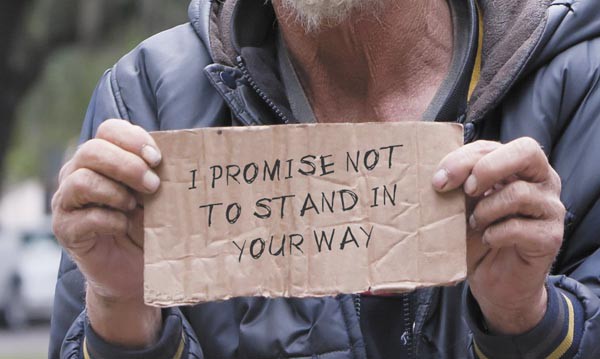
I was then puzzled about my role as the Holy Beggar. Did I indeed have to get out on a street corner, begging bowl in hand, perhaps a dog or other attention - sympathy getter at my side, a compellingly designed and annotated sign professing my sincerity, need, etc.?

I recently saw such a fellow HB, he was about 30+, clean shaven, baseball cap, jeans and a T shirt, day pack, cardboard sign, "Need help. Please!" standing on the medial strip before a freeway on-ramp. I was on my way to my volunteer job.

Instinctively I plunged my hand into the Holy Begging purse and pulled out a dollar, signaled for him to come and gave it to him. He had a nice manner, thanked me. I then asked whether he was out of work (Yes. I'm a day laborer and didn't get work today. I need money for food.) I told him I was out of work myself, over a year. He agreed it was tough out "here" and thanked me, again.

The light turned green and I entered the roadway.

So, while I wasn't personally begging, I made a connection and felt that I empowered him to do it for me. He held my place and that of millions of we folks out of work in this miserable economy. Thus, I was doing what I did well and perhaps he was doing OK, too.

Something to consider. I think there's some sort of spiritual rightness about it. We are helping each other.

I really miss spending money doing mitzvot (good deeds) even in simple ways.

Monday, March 1, 2010

Unemployment Compensation Blues

Back in the 1960s I was an avid "folkie", playing my guitar every day, transcribing tunes from the static-ky Philadelphia fm station so that I could keep up with some of the more rooted but nonetheless topical songs of the period. Tonight I remembered one of my favorites, "Unemployment Compensation Blues", words and music by Les Pine, adapted by Jerry Silverman, copyright 1949 by People's Songs, Inc. that was transferred to SING OUT in 1957) and published in Sing Out! volume 3. It has a sweet blues-y tune that doesn't seem to salve my growing resentment about the current situation. The lyrics are not really dated (except for the fact that there are fewer requirements to have a meeting with an EDD staffer (thank heavens!)

I've got those
Unemployment compensation
What was your last occupation blues.
I've got those
How much money did you earn
Stand in a line and wait your turn blues.
They make me feel I'm committing a sin
To get back part of what I paid in.
I've got those
Have you had an interview
Come back in a week or two blues.

I've got those
Unemployment compensation
Please fill out an application blues
I've got those
State your weekly minimum
You don't wanna work you bum blues
And when I'm thru with my weekly routine
I spend my money on thorazine
I've got those
By the time I get my check
I become a nervous wreck blues.

I've got those
Unemployment compensation
It ain't worth the aggravation blues.
I've got those
Won't you wait, just have a chair
Nothin' in my frigidare blues
I'm tired of fellin' like a jerk
All I want is a chance to work
And lose those
Out of work humiliation
Unemployment compensation blues

I may update it with a few verses, including stimulus, extension, COBRA, online / e mail job hunt, etc.
Stay tuned (as much as one needs for folk music ...)

No matter what,
Don't forget to ask for the money!


Thursday, February 18, 2010

Adopt-a-Pothole on Wilshire Blvd., Los Angeles

I am encouraged! The developing nation shall lead the arrogant ones!

Who will join me in this enterprise to repair Wilshire Boulevard in Los Angeles?

To wit: http://www.adopt-a-pothole.org/

The Adopt-a-Pothole is a new Social-Economic Enterprise, which addresses key fundamental needs in South Africa, being road infrastructure maintenance, and the alleviation of unemployment and poverty in local communities and promotes the principles of custodianship and leadership rather than ownership and entitlement.

The project has been designed as a practical business and enterprise development incubator, and it will recruit, train and mentor unemployed individuals as business unit caretakers, admin and support officers, and pothole doctors in the developing social entrepreneurship arena.

The project was designed using a multiple cluster model, with each cluster comprising of 5 independently managed business units positioned within a social-economic franchise model.

This programme is structured to leverage CSR, Social Economic and Enterprise Development funding mechanisms as well as marketing budgets of large and medium corporations. Profits generated will be shared between the programme expansion cost and pre-defined beneficiaries.

And then let's adopt-a-lightbulb for the streetlights that are out! It's so annoying to see that cluster of "art" streetlight poles at LACMA ... when the ones we need for visibility (and safety!) are out everywhere.

Friday, January 29, 2010

Wisdom From The Mirdrash

From the teaching of Rabbi Adin Steinsaltz via Rabbi Arthur Kurzweil (www.arthurkurzweil.com)


Some people live in their own narrow world and are stingy to themselves.


But they do so not out of miserliness, for there are people who can realize that other people are in need but fail to see that they themselves are no less in need.


There is a story in the Midrash Rabbah about some scholars who came to a city to raise money for charity.


They sent one of their number to observe the household of a certain illustrious citizen in order to ascertain how much to ask of him.


The scholar came to the house and by chance over­heard the rich man scolding his wife, insisting that she buy a cheaper brand of lentils for their table.


The scholars therefore did not even bother to approach him for money but collected their charity from others.


They explained the reason, and he answered, 'Concerning that which belongs to me, I chose to be stingy, but about that which belongs to God I prefer to be generous.'"


So, as you can see, the following is so deeply true ...


No Matter What,

Don't Forget to Ask for the Money!

Thursday, January 28, 2010

Holy Beggar’s Epiphany: I’m Really a Giver!

Hold on to your begging hats and bowls. My begging days may be over. While looking for that illusive next career move from Holy Beggar to HOLY BEGGAR, I understood the basic flaw in my premise ... I’m really much better a giver than a receiver.

In this world there’s giving and receiving, the host and guest, a thank you and you’re welcome, the latter being almost an endangered species. How many people do you know who say “You’re welcome” vs. “thank you”? I bet more the latter than the former.

Well, with a deep bow to retro-ness, I’m going to focus on the giving side of the philanthropy “equation” and make it simple, personal and, hopefully, impacting.

You heard it here first, dear reader.

Your Holy Beggar is going to undergo a transformation. Not because it is better to give than receive, although there’s a nice balancing ring to it, rather because it is possible to give. It may make me smile. It will help others.

More later.

In the meantime,
No Matter What,
Don’t Forget to Ask for the Money!