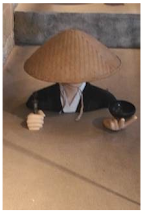
What a strange job ... "profession of empathy". Isn't this what your Holy Beggar does in fact (vs in a think tank)?
Anyway, this is my comment (below) and I'll post a link to the write-up about the live event.
Which comes first: the need or desire to give? According to
my teacher Gilla Nissan, the first word of the first verse of Genesis is easily rendered as “creates an offering”. This promotes the notion that gratitude and the means
to express it are inherent in the very creation of existence; that we are
always in a position of negotiating an exchange, of giving and taking.
According to Jewish tradition, it’s not just as a matter of
empathy -- " ... what it must be like to be in her situation." To
stop here would be to yield to a dualistic understanding of who I (vs?) and you
are / am. A full understanding of gemilut chassadim requires more than such sensitivity. In practical and
spiritual terms, these acts of loving-kindness – together with a knowledge and
appreciation of the standards of being human and determination to take
responsibility for action -- bring about "tikkun olam", the repair of
the broken vessel of existence that we all share.
The eminent Vietnamese Buddhist monk and Nobel Peace Prize
nominee Thich Nhat Han describes this greater reality as “inter-being” … you
and I “inter-are”. I am already part of “her situation.”
Judaism’s mitzvot, spiritually
weighted deeds, are specific actions to this end. When a boy or girl at the age
of 13 is declared a son/daughter of the mitzvot (bar/bat mitzvah), s/he is
accepts personal responsibility for such behavior in the presence the
community.
I also must impulsively respond and only “… lean on my imagination
…“ as to what is needed in a
situation. Consider what colonialist Europeans "knew" and thus
projected on their “discovery” of native peoples (who wondered the same thing)
when they landed on the shores of the "new world". Even if I could
empathize with the “obvious” situation of who is in front of my nose seemingly
hungry, in need of clean clothes and a safe place to sleep, my imagination is
always limited, and, thus, my conclusion and response may be inaccurate, even
harmful I quickly abandoned the notion of “quaint” after visiting economically
impoverished neighborhoods in southern Africa and seek a deeper understanding
of the dimensions of Bhutan’s “Gross National Happiness”.
These are some of the concerns that I have been addressing
throughout my 40 years in the nonprofit “sector”. Perhaps this is why the
"role" of beggar exists among us across time and space of human
experience. I’m exploring these ideas in my blog www.holybeggar.blogspot.com.
P.S. The larger discussion now has passed. One may audit it here. It was none too cleverly subtitled: "Take Two MItzvahs and See Me in the Morning", but it was more than that. Bravo, Zocalo.
P.S. The larger discussion now has passed. One may audit it here. It was none too cleverly subtitled: "Take Two MItzvahs and See Me in the Morning", but it was more than that. Bravo, Zocalo.